


I’m hoping that - given the subject - my comrades at The Times won’t mind me adding the original text of this article to my Substack. Some of you have found it difficult to locate as it runs second after Isolde Walter’s piece. Others may not have a Times subscription (I urge you to consider a trial - I have the cheapest option and live for it. Quality journalism costs and all that.)
Here’s the piece as it reads in the paper (again, it’s after Isolde’s). And here it is as it looks online.
My version is lengthier, more teary. Those who read both will see what incredible editors I am fortunate to work with. It’s not easy writing about stuff like this, but I’m convinced it’s vital, and having genius friends take charge of it is everything.
I wrote “on-edition”, as we say, in response to the inquest for Thomas Kingston, Lady Gabriella Windsor’s husband, who ended his own life, and her call for more information around SSRIs (selective serotonin reuptake inhibitors), a class of antidepressants I’ve been taking since 2010.
The key takeaway (ghastly phrase) is that: “the period in which one starts or stops an SSRI is extremely dangerous. Your brain chemistry is adapting. And your suicide risk actually increases, not least because you have taken steps and expect to be cured but aren’t. This proves especially challenging in volatile adolescent brains, but is an issue for us all.” Everybody needs to know this, yet painfully few do. I, like Lady Gabriella, only found out though bitter experience, albeit not as bitter.
However, I should also stress, as I do below, that “I have never had any problems with citalopram, only positives…Almost nine million people in England are taking SSRIs because, for the most part, they work, the more pressing risk of suicide lying in not taking them.” Read on if you’d like more.
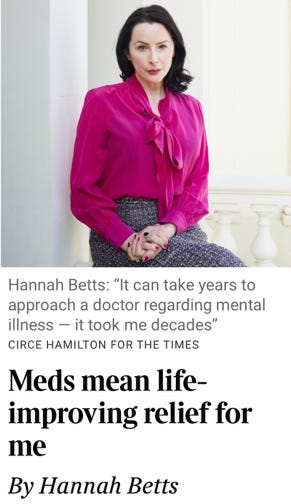
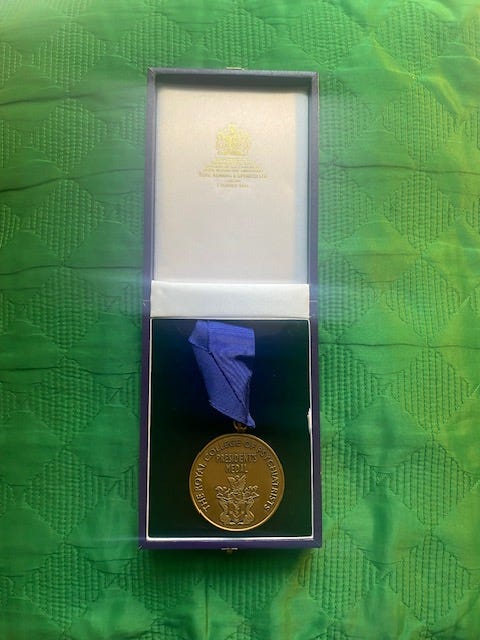
The wonderful Circe Hamilton took the portrait. I like it. It feels like the “real me,” whoever that is - quiet and squinty in sunlight - not doing jazz hands for once. Oh, and I dug out my medal from the Royal College of Psychiatrists (see the image at the bottom). Indulge me showing it off. My psychiatrist father didn’t live to see it and he would have been fucking proud.
More very soon including an explanation as to where the hell I’ve been.
VAST LOVE,
H.
By Hannah Betts
People talk about their “heart going out” to relatives of those who have killed themselves. Family members such as Lady Gabriella Windsor, who called for more awareness about the risks of taking antidepressants at the inquest for her husband, Tom Kingston.
Personally, I feel as if my heart might break. It’s a tight, suffocating sensation involving actual physical pain brought about by those close to me who have taken this step - and those I dread still might. It’s the sitting with your loved one having finally persuaded them to be honest, while every fibre of your being wants to claw them to you and plead: “Don’t do it. Don’t even think it. How would my life go on?”
It’s the sudden call from a stranger that leaves you shocked beyond comprehension, yet, grotesquely, not surprised. It’s the wondering what their life would have been a year, ten, twenty-five years on. It's the motherless infants, bereft partners, and ageing parents round-mouthed at the horror of the thing.
And, yet, my reaction is complicated by the fact that I’ve known how blistering suicidal misery can feel: the blank-brained illogic that life would be easier – better - for all concerned were one simply not around. I should say at once that I am fortunate never actively to have contemplated suicide. Too energyless, perhaps, too immobile when wretched. Still, I have become so swallowed up by the weight of my pall that I have been, say, careless of my safety. While many’s the time I’ve soothed myself to sleep with thoughts of filling my pockets with rocks and taking to the Thames, some low-rent Virginia Woolf.
Sane me knows that this would be not a peaceful, but violent, traumatic way to go, leaving great unhappiness in its wake. The bridge in my fantasy now has signs attached to it every few steps offering help – and I’m glad of it. As was argued during last week’s assisted dying debate, we need to achieve assisted living first. Still, I refer to my conflicted emotions about suicide to save others from shame - about their depression, their mood, themselves. And to illustrate that I have “skin in the game” – a laceratingly apposite phrase, recalling loved one’s battered bodies.
I also have skin in the game when it comes to SSRIs, selective serotonin reuptake inhibitors, a class of antidepressants used to treat depression and anxiety. Thomas Kingston shot himself having taken sertraline for four days, followed by citalopram, which he ceased taking after two tablets. The coroner, Katy Skerrett, announced she will draft a prevention of future deaths report to address whether there is adequate communication of the risk of suicide for people on SSRIs, and whether that advice should be altered if a patient is agitated early in taking the drugs.
I was prescribed citalopram on 27 July 2010 and have been on it ever since. I now consume a daily 40mg of escitalopram, a tweaked version. I know this to be a high dose, as I was once called by a pharmacist while on stage judging a dog show to be informed that it was too much and I would have to cut back. I made my case to remain on 40mg and have no intention of coming off it. I haven’t taken sertraline, but people close to me have, and I have always felt that - of the two - citalopram is the less tricky; sertraline appearing to involve greater mood-swings when venturing on and off it. However, this is anecdotal – experiences, like brains, vary.
I have never had any problems with citalopram – only positives - and feel this should be emphasised. Most people experience nothing other than a bit of a dry throat at first, then dawning, life-improving relief. Almost 9 million Britons are taking SSRIs because - for the most part - they work; the more pressing risk of suicide lying in not taking them.
However, I am aware that the period in which one starts or stops an SSRI is extremely dangerous. Your brain chemistry is adapting. And your suicide risk actually increases, not least because you have taken steps and expect to be cured, but aren’t. This proves especially challenging in volatile adolescent brains, but is an issue for us all. I’ve had people close to me become dangerously ill during this process, and (literally) been by their side to ensure they don’t injure themselves.
I know this – like Lady Gabriella - through bitter experience, if not as bitter. I am also friends with psychiatrists, the daughter and granddaughter of psychiatrists, with a prize from the Royal College of Psychiatrists reflecting my interest in this area. It is not something that patients hear from their GPs - and that is an issue that urgently needs addressing.
Doubtless, there is an element of not wanting to deter people from seeking help via medication here, which I understand. It can take years to approach a doctor regarding mental illness. It took me decades. While the anti-drug lobby is as vicious as it is vociferous. If I venture online, I find I have been condemned as a Big Pharma stooge merely for writing that SSRIs have helped me enjoy a functional life; which they unquestionably have. Still, I agree with Lady Gabriella, that patients – and their loved ones - need to know what they may be confronting during those first medicated weeks.
That said, those of us with depression are in a perilous category regarding suicide as it is. We’re not people who suddenly become suicidal – some inkling of it, at least, will be present for us to qualify for help. I am more sorry than I can express that Thomas Kingston died after taking SSRIs. Nevertheless, I aim to die on them. And I hope that the solution they can ultimately provide continues to be sought by millions for whom not taking them is the more dangerous option.
Thank you for this. There is far too little understanding of how depression can be (literally) deadly without medication - people afraid of blanket prescriptions of tranquillisers, a feeling from those who have never suffered depression that one can just decide to snap out of it.
Great piece as always Hannah. It’s so important to understand how SSRI’s work, the differences between them and how essential it is to get the right one and dose for you. A good GP is important as is the ability to speak up when tweaks are needed , not made easy for too many people.